Reimagining Patient Notifications at Citizen Health
How I helped turn fragmented messages into a clearer care experience
About Citizen Health
A digital health platform, helping patients access and understand their medical records
Citizen Health helps patients with rare diseases access and manage their medical records by handling the fragmented process of record collection across healthcare providers. By managing the behind the scenes work, the platform enables patients to turn their health data into actionable knowledge that help patients better understand their condition, next steps, and allow them to advocate for their care.
Framing the Problem
Patients lacked clarity during the records collection journey, and teams were compensating manually
Notifications are the primary way patients understand what is happening in their care journey. However, Citizen Health’s system had grown fragmented over time.
Patients experienced:
Unclear next steps during records collection
Inconsistent tone and branding across emails and in app messages
A lack of confirmations after completing actions
Internal teams experienced:
Manual email workflows increasing reliance on Patient Support
Limited visibility into what messages were current vs. inactive
Up to 60% abandonment rate in records-related emails
This made records collection one of the highest points of friction in the patient experience.
A Little About My Role
Owning a complex communication problem end to end
When I joined Citizen Health as a Product Design Intern, I was set on a task to explore the question:
How do we communicate with patients today, and where are we falling short?
I owned the audit, analysis, and design strategy for improving patient notifications, with a specific focus on the medical records collection flow. I partnered closely with Records Operations, Patient Support, the Product team, and Engineering to move from fragmented messaging toward a scalable, trustworthy communication system.
By the end of my internship, I had completed a gap assessment and provided production ready designs across email, in app messages, and notifications, establishing a foundation for future improvements.
Final Deliverable
Production-ready designs a cohesive, end-to-end records collection experience
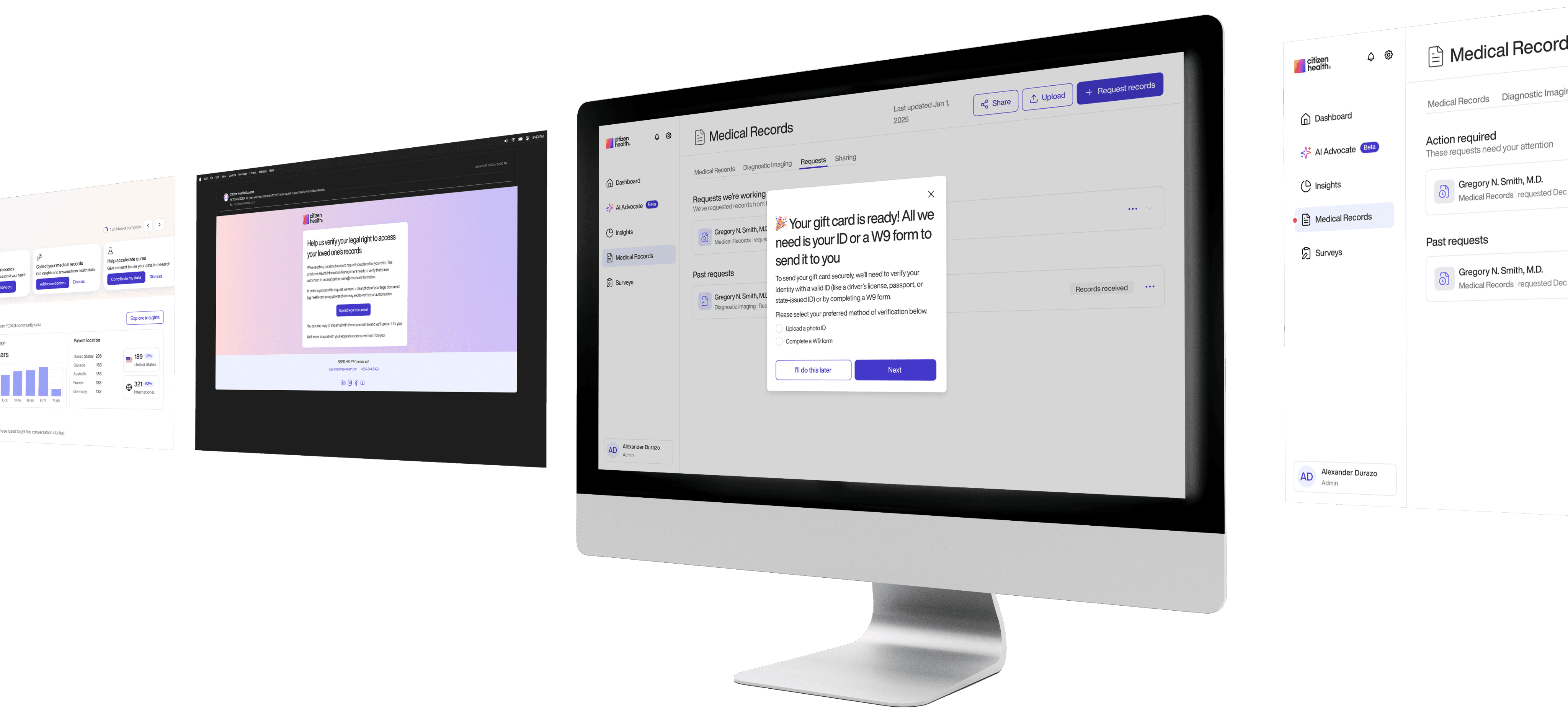
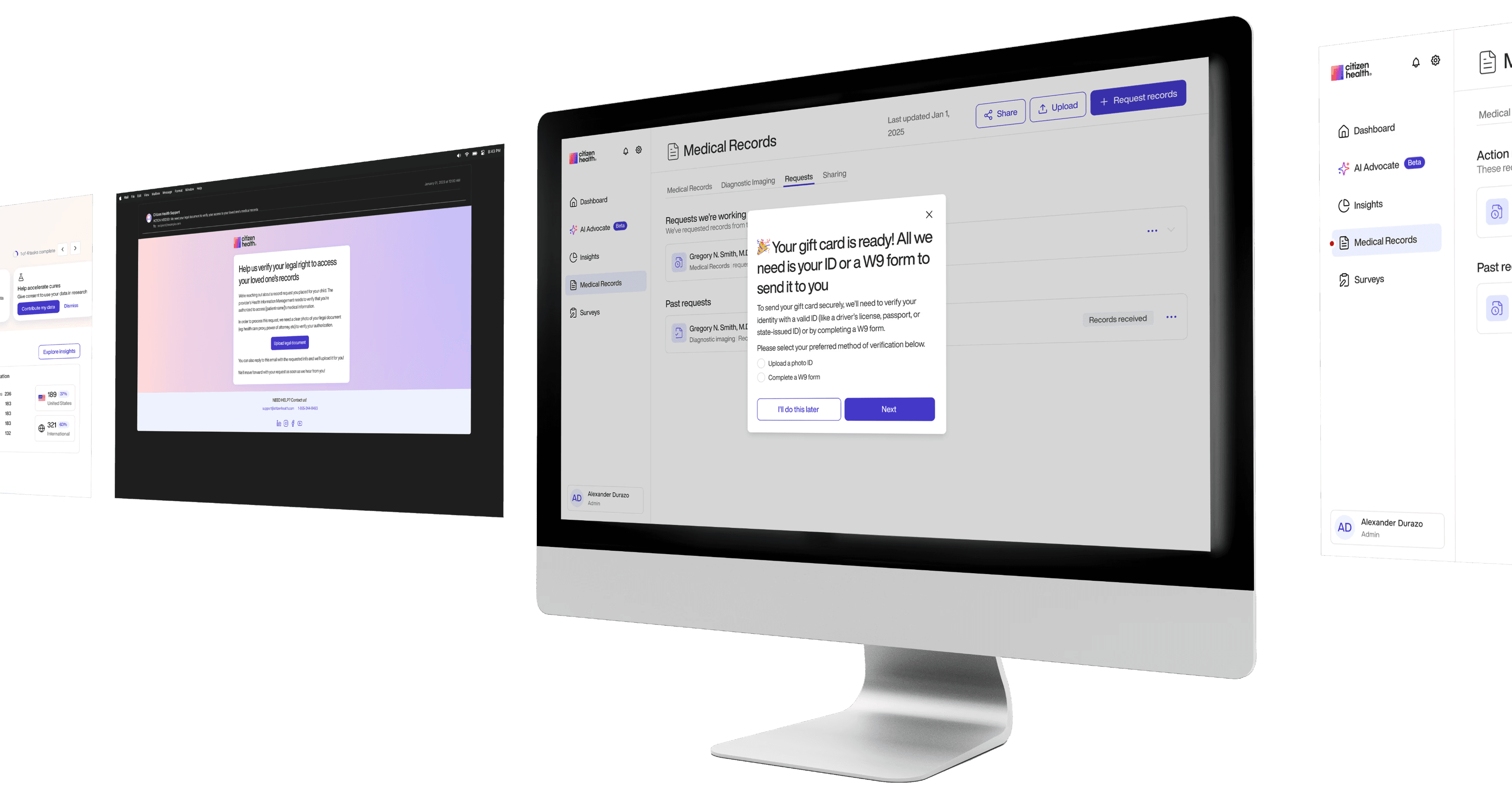
My final deliverable focused on improving the underlying communication system across records collection. This included redesigned email modals, status updates with clearer CTAs and progress visibility, a detailed service blueprint, and comprehensive flow documentation covering both ideal and edge-case scenarios.
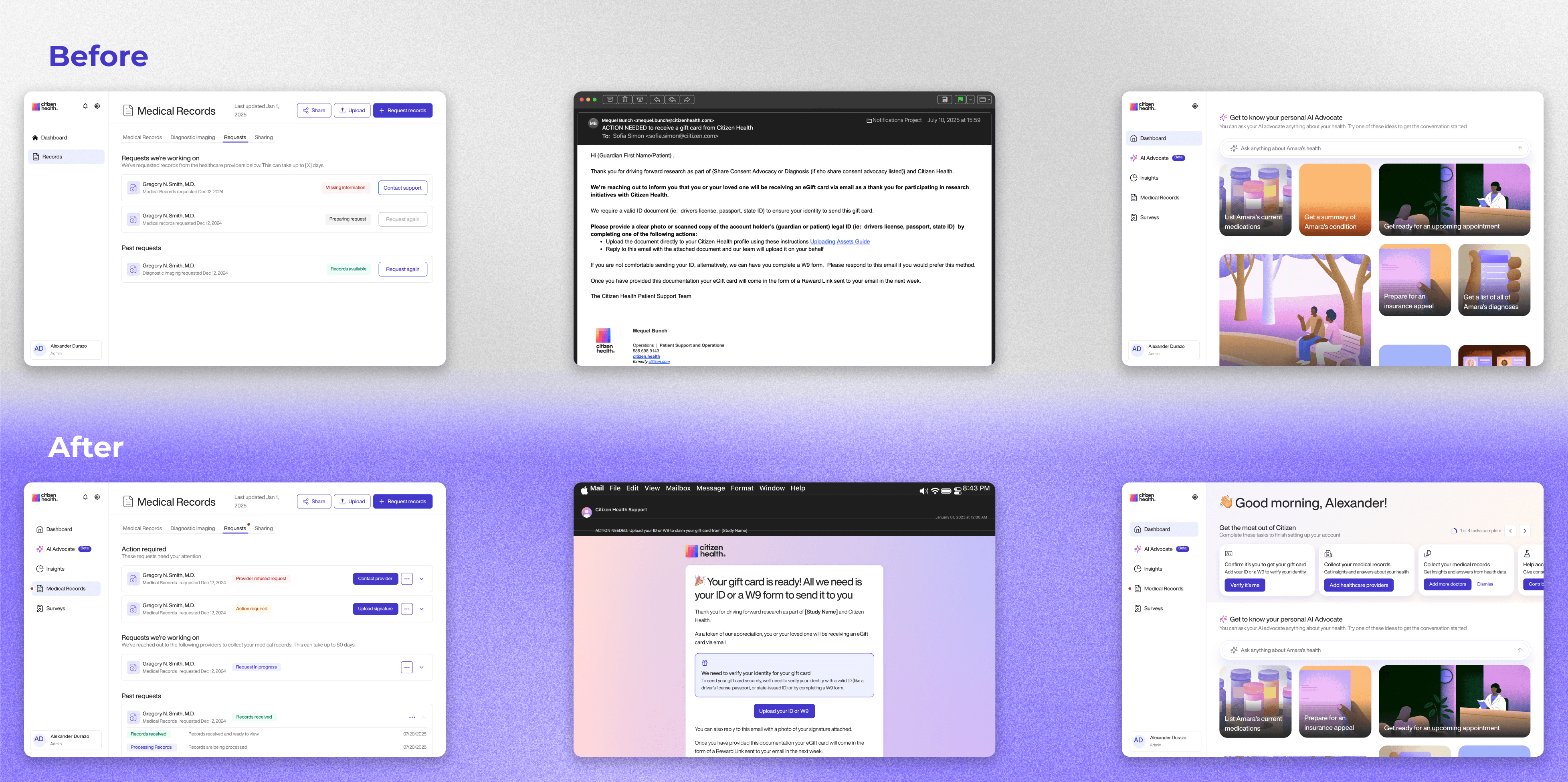
Before and after system updates across the records collection journey, including clearer statuses, actionable CTAs, redesigned email modals, and improved progress visibility.
Narrowing in on What to Solve For
Designing for confidence, clarity, and timely patient action
Before jumping into solutions, I worked with the team to align on what good communication should feel like.
We centered the work around three core goals:
Understand how we communicate with users today and identify gaps and opportunities to improve
Improve communication with patients throughout the record-collection process
Drive Engagement with the AI Advocate
From there, three guiding principles emerged:
Empower patients by proactively delivering updates rather than making them seek it out on their own
Always ensure the patient knows what to do next
Encourage engagement through AI-personalized nudges
How I Approached the Problem
I started by mapping the mess
Notifications lived across multiple platforms, including HubSpot, SendGrid, and Salesforce. No single team had full visibility into what was being sent, when, or why.
I conducted a comprehensive audit of all notification within Citizen Health, mapping:
Which platform was sending what
How the notification displayed
The reason for the notification
Whether it was automated or manual
Who the recipient was
What triggered this notification
Noting potential need for change
Ranking priority
Category (Transactional, Marketing, System Alert, etc.)
What user action was called for
What notification channels were being utilized / called for
Which phase they aligned with in Lifecycle Marketing
This revealed issues such as duplicated notifications, inconsistencies in ownership, and no single source of truth.
Then, I mapped the end-to-end patient journey through notification within the records collection workflow
Because records collection accounted for a large share of patient emails, I partnered with Records Operations to map the full service blueprint, including edge cases.
This helped me to pinpoint where:
Communication was missing
Statuses were unclear to patients
Patients were expected to act without proper calls to action
What I Found
Communication gaps were driving drop off and manual work
Across the audit, patterns emerged quickly.
At a system level:
No visibility into which notifications were active
Lack of clear engagement metrics
Inconsistent voice, tone, and branding
Emails missing clear calls to action
Heavy reliance on manual sending
Within records collection specifically:
Patients often did not know when action was required of them
Status updates were inconsistent, unclear, or missing
Support emails with unclear CTAs saw high levels of abandonment
These insights made it clear that improving communication during records collection would deliver the biggest immediate impact.
From Insights to Implementation Through Focused Communication Updates
A Q3 plan to prioritize focusing on record-collection communication gaps and reducing support burden
Rather than redesign everything at once, I proposed a focused Q3 strategy centered on improving communication where patients struggled most, records collection and statuses.
The goals were simple:
Reduce time spent by support teams resolving Record Operations issues
Reduce the number of cases closed due to missing patient action
To achieve this, I designed solutions that ensured:
Every user action ends with confirmation and next steps
Emails feel cohesive, consistent, and trustworthy
Calls to action are clear, timely, and actionable
What Shipped
Turning insights into production ready designs that teams could actually use
With a clear strategy in place, I focused on delivering tangible improvements that patients and internal teams could rely on immediately. The goal was not just to improve individual touch-points, but to create a cohesive communication system that scaled beyond a single workflow.
By the end of my internship, I delivered:
A redesigned records request tab that made progress and status more transparent for patients
Updated statuses, emails, toasts, and in app messages across the records collection flow, ensuring every user action ended with confirmation and clear next steps
Dev ready, reusable email templates with consistent branding, tone, and action focused CTAs
Extended notification patterns that could be applied across additional workflows beyond records collection
Together, these changes reduced reliance on manual communication, improved clarity at critical moments in the records flow, and established a foundation for future notification improvements across Citizen Health.
Beyond the MVP
Scaling the notification system to deliver proactive, patient-centered communication
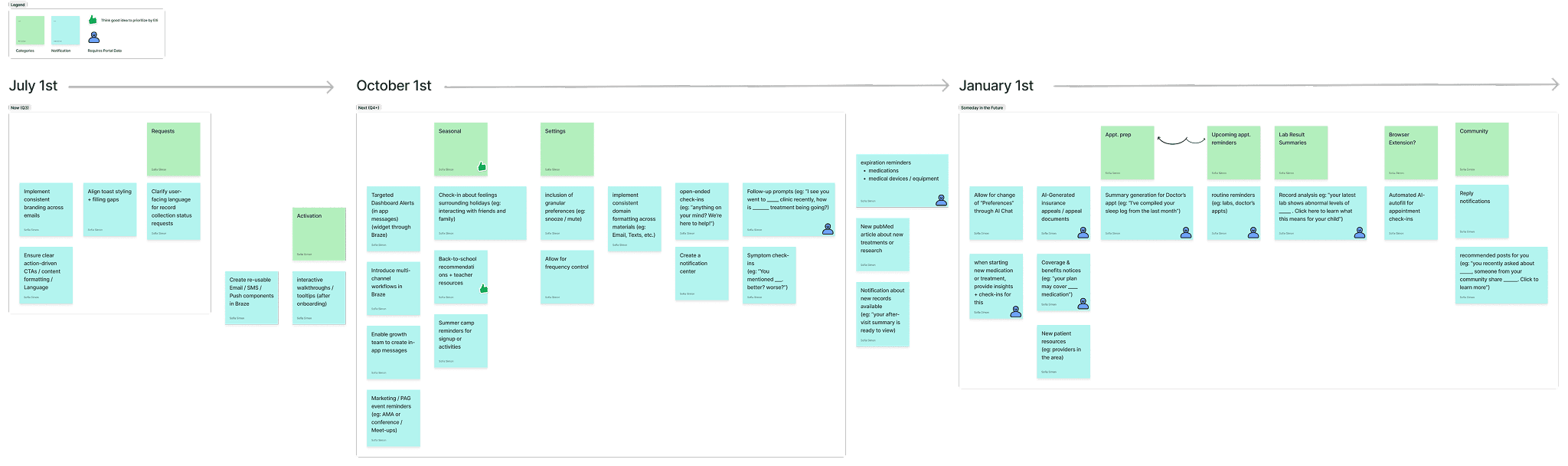
With the core system in place, I explored how notifications could evolve from reactive updates into more supportive, personalized touch-points throughout a patient’s care journey.
Future opportunities included:
Context aware AI check ins tied to “AI Advocate” patient conversations and progress
Seasonal and condition-based reminders to support ongoing care
Preference-driven notification controls to reduce fatigue
A centralized in-app notification center for visibility and control
Targeted dashboard alerts and engagement messages
Together, these concepts show how notifications can move beyond status updates to provide timely, relevant support throughout a patient’s care journey.
Conclusion
What this project taught me
This project reinforced that communication is a core product experience, not simply an afterthought.
This project strengthened my ability to:
Design at a systems level rather than focusing only on screens
Collaborate closely with operations, support, PMs, and engineering teams
Balance immediate UX improvements with long term scalability
Advocate for patient clarity in complex healthcare workflows