Reimagining AI from a Solo Tool into an Effective Shared Workspace
How we enabled teams to collaborate in one continuous AI conversation
My Role
Product Manager
Industry
AI Tech
Timeline
5 weeks
Toolkit



Framing the Problem
Users are trying to use AI in collaborative workflows, but AI is not yet designed to handle this task
ChatGPT has become a core workspace for many when it comes to drafting, planning, and problem-solving. Despite teams attempting to use ChatGPT for their day-to-day activities, teams are forced into isolated workflows:
Each team member's conversations live in different chats
Context is lost within teams
Work must be manually consolidated
Duplicate chats are common
Why now?
As AI becomes embedded in team workflows, expectations are shifting. Modern tools like Figma and Google Docs have set expectations for real-time co-creation, while AI products remain largely individual-focused by design. This gap represents both a usability failure and a market opportunity.
The core problem
ChatGPT lacks native support for shared context, authorship clarity, and continuous collaboration, causing teams to fragment their work across tools.
A Little About My Role
Helping define the product strategy behind collaborative AI
I was part of a team, with 3 other members. I specifically worked on defining a new product direction for ChatGPT, reframing it from a single-user assistant into a collaborative workspace by shaping the business strategy, product foundation, and roadmap direction.
My contributions focused on:
Developing the opportunity hypothesis around collaborative AI workflows
Building the Lean Canvas model to define user value, differentiation, and market opportunity
Defining customer goals and internal business goals within the PRD
Crafting positioning and marketing messaging for the product concept
Establishing activation KPIs and success metrics to measure adoption and engagement
Final Deliverable
Defining the product and business strategy behind a collaborative AI workspace in ChatGPT
Our final deliverable consisted of a strategy report that focused on translating the collaborative workflow problem into a structured product opportunity. This included defining the market gap, shaping product positioning, outlining customer and business goals, and establishing success metrics tied to adoption and engagement.
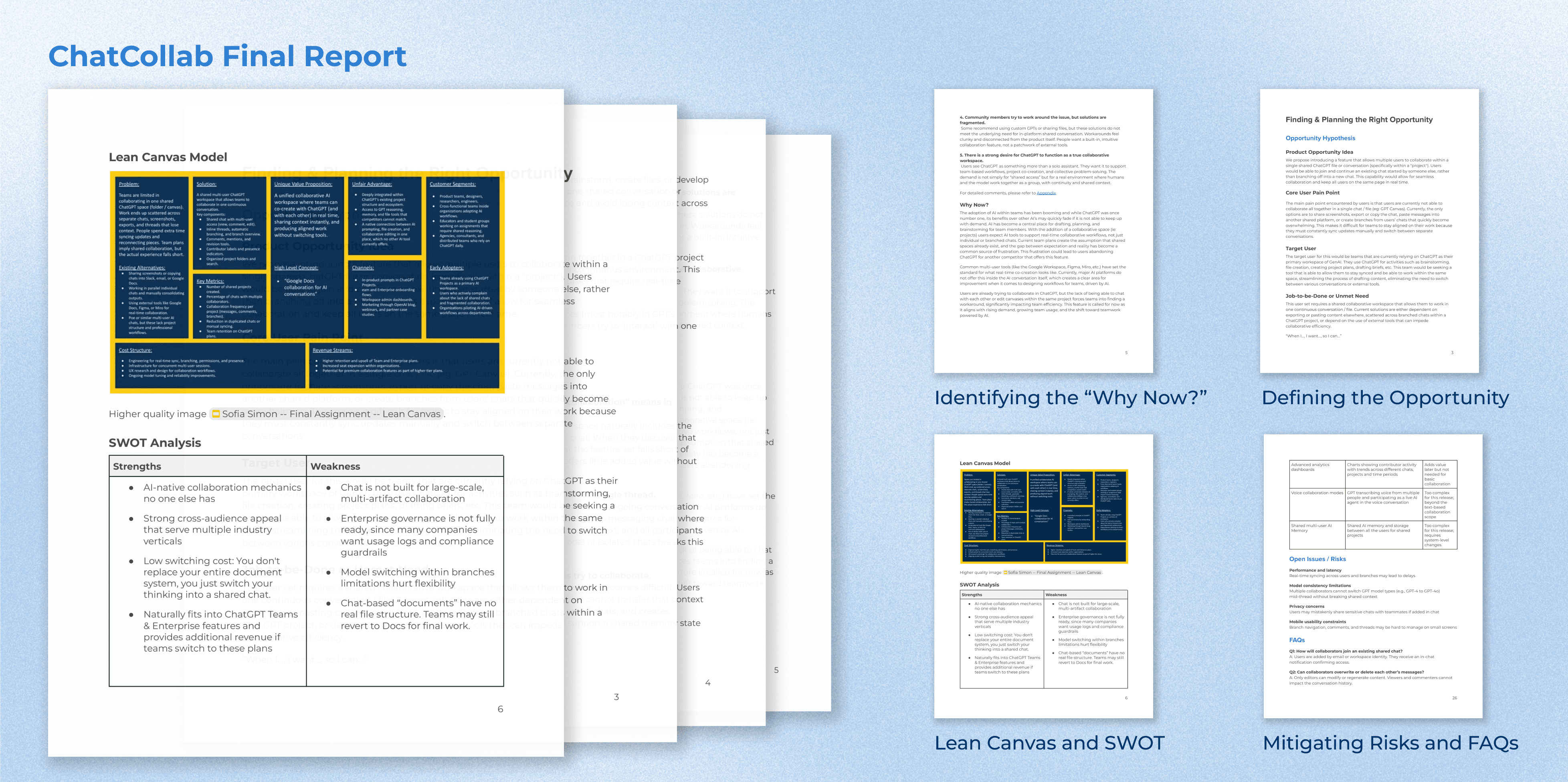
Selected excerpts from the final strategy report covering opportunity framing, product positioning, business modeling, and risk mitigation.
Narrowing in on What to Solve For
Defining our north star for an effective AI-driven workspace
Before jumping into solutions, we aligned on what “good collaboration with AI” should look like.
We centered the work around three core goals:
Enable real-time and async collaboration in one shared space
Maintain a single, continuous source of truth
Reduce duplication and context loss across teams
Shaping the Solution
Defining the core collaboration features needed to support AI-powered teamwork
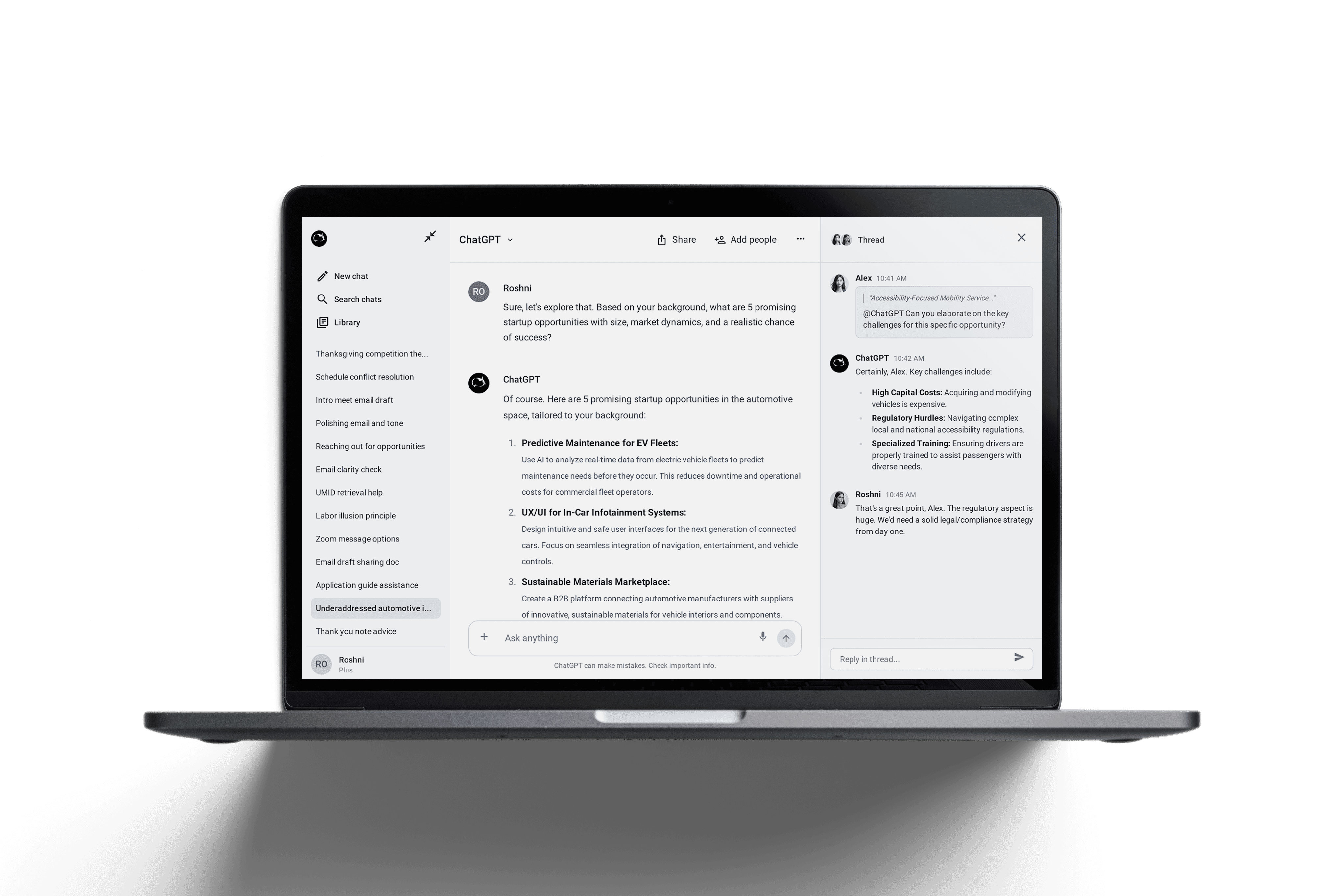
Our solution, ChatCollab, introduces a shared ChatGPT workspace with structured collaboration built directly into the chat experience.
Multi-user shared conversations Threads & automatic branching to support parallel thinking Comments, mentions, and AI-assisted revisions Role-based permissions (view, comment, edit) Project organization (folders, search, filters) Presence indicators + follow mode
Its core capabilities include:
Multi-user shared conversations
Threads & automatic branching to support parallel thinking
Comments, mentions, and AI-assisted revisions
Role-based permissions (view, comment, edit)
Project organization (folders, search, filters)
Presence indicators + follow mode
Together, these features enable teams to:
Collaborate synchronously or asynchronously
Maintain a continuous, traceable workflow
Eliminate version chaos and duplicated effort
Digging a little deeper into the MVP
Threads and Branching:
Inline threads for focused discussions
Automatic branching to prevent context collision
Parallel conversations within one shared workspace
Real-Time Collaboration:
Multiple users interacting in the same conversation
Presence indicators and contributor visibility
Structured Feedback:
Inline comments and @mentions
AI-assisted revisions based on team input
Workspace Organization:
Project folders, search, and filtering
Clear navigation across complex conversations
Transparency & Attribution:
Contributor labels (human vs AI)
Traceable decision-making across iterations
Considering the Business Impact
Solving collaboration friction at both the user and organizational level
ChatCollab explores how structured collaboration built directly into the chat experience creates value for both users and the business.
User Value
Teams move faster without losing context or visibility across conversations
Reduced workflow fragmentation across tools and chats
Faster collaboration and review cycles
Improved transparency across decisions and iterations
Clearer ownership through contributor attribution and branching
Business Value
Embedding collaboration directly into ChatGPT creates stronger long-term retention for teams and enterprise users.
Increases adoption potential for Team and Enterprise plans
Improves retention through deeper workflow integration
Expands competitive positioning against current competition: Google Workspace, Microsoft Copilot, Anthropic, etc.
Differentiates ChatGPT beyond single-user AI experiences
Predicting Success Metrics
Measuring whether collaborative AI improves team workflows
To evaluate the effectiveness of ChatCollab, our success metrics focus on collaboration adoption, workflow efficiency, and long-term engagement.
Suggested metrics to evaluate success:
+20% increase in shared workspace creation
+10% growth in monthly multi-user conversations
−25% reduction in duplicated or parallel chats
+10% improvement in team retention and recurring usage
Additional areas where success could be evaluated might include: checking for increased engagement with comments, mentions, and threaded discussions or looking for a higher percentage of conversations involving multiple contributors
Conclusion
What this project reinforced for me
AI is no longer just a productivity tool, it is becoming an active participant in team workflows.
This project strengthened my ability to:
Frame ambiguous problems into clear product opportunities
Design for systems, not just interfaces
Balance user needs with business strategy and technical feasibility
Translate complex workflows into scalable product concepts